
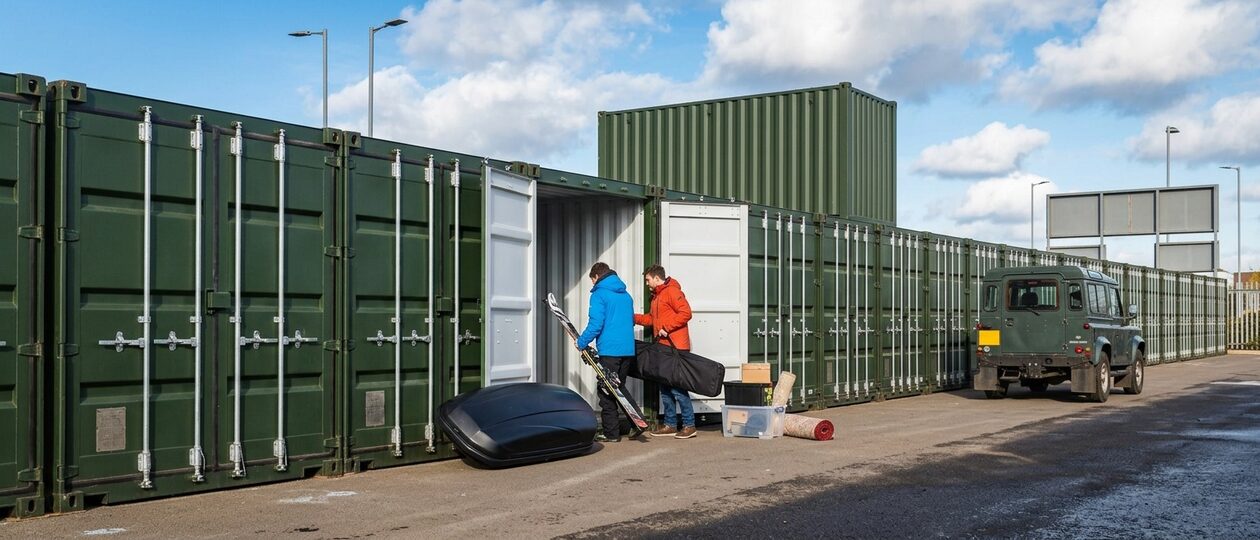
Teesside gets about 18 days of snow a year on the North East regional average, and none of it is skiable. There is no slope in the Tees Valley; the nearest indoor real-snow centre is at Castleford in West Yorkshire, over an hour’s drive down the A1. So for most local skiers and boarders the season is one or two weeks abroad, December to April, and the kit comes out of the cupboard for that fortnight and goes back in for the other fifty weeks.
That cupboard is the problem. A pair of adult skis is 150 to 180 cm long, a snowboard 140 to 165 cm, and a roof box to carry them runs to about 2 m. A one-bedroom flat in Stockton rents for around £536 a month in the year to August 2026, and none of that floor area was designed around a two-metre plastic box.
Why does ski kit take over a Teesside home?
Because every piece of it is long, awkward and used for two weeks a year. A family of four going once a season owns four pairs of skis or boards, four pairs of boots, poles, helmets, bags, jackets and salopettes, and the roof box to get it all to the airport or across to the Alps by car.
Laid out, that is a footprint of two metres by a metre at least, before anyone stands the skis up. In a terrace with no garage, a town-centre flat or a new-build with a loft hatch the size of a tea tray, it lives in the hallway, behind the sofa or on top of the wardrobe. The roof box lives on the car all year, costing fuel, or on the garage floor where the car should be.
Between trips: the care routine
Kit put away wet and in a hurry is kit that comes out rusty, mouldy or warped in December. Half an hour the week after the trip saves it.
| Item | After the trip | Where it can live |
|---|---|---|
| Skis | Dry fully, wipe edges with light oil, thick coat of storage wax left on, brakes banded, bases together with foam between | Wall rack, above a wardrobe, in a bag in a unit, never a damp garage floor |
| Snowboard | Dry, storage wax on, bindings loosened or off, stood on edge or flat with nothing on top | Under a bed, behind a door, flat on a shelf in a unit |
| Boots | Dry the liners out of the shell, buckle loosely so the shell keeps its shape, no heat source | Boot bag in a cupboard, off a concrete floor |
| Jackets and salopettes | Wash with a technical wash, re-proof, air fully, hang | Wardrobe, or a breathable bag in a unit |
| Helmets and goggles | Wipe, air the padding, goggles in their soft bag | A lidded box, out of sunlight |
| Roof box | Wash, dry inside and out, lid cracked open to air | On its side against a wall, hoisted to a garage ceiling, or along the wall of a unit |
Nothing goes into polythene. North East air sits at 83% humidity on average, and a sealed plastic bag with damp kit inside is how liners go green over summer. Breathable bags, a moisture trap in any closed space, and everything bone dry first. The same rules as our damp and sea air post, because the enemy is the same.
Where can it live at home?
Up high, flat, or on a wall. A loft with a proper ladder takes skis and boards laid flat along the joists and the roof box if the hatch is big enough, which in a new-build it often is not. Under-bed space takes a board and the boot bags. A wall rack in a hallway or a spare room takes skis vertically and looks fine. Jackets go in the wardrobe like any other coat.
The honest limit is the roof box. It does not go in a loft hatch, under a bed or on a wall, and a flat has nowhere for it at all. A garage with a hoist, a friend’s shed or a storage unit are the real options, and for a lot of households the roof box is the single reason the rest of the kit ends up in storage too.
Sharing the problem: the shared small unit
A storage unit for ski kit makes sense when several households that travel together put everything in one space and split the cost. A 10ft container, roughly a large shed, takes four or five families’ skis, boards, boots and bags with the roof box along the long wall, and still has room to walk in and find your own stuff.
| 10ft container shared between | Each pays, per month (inc VAT) |
|---|---|
| 1 household | £90 |
| 2 | £45 |
| 3 | £30 |
| 4 | £22.50 |
Guide prices, checked 2 October 2026. Sizes and availability change from week to week, and not every size is offered at every site. For what's available today, with live prices, see the Ingleby Barwick, Stockton (Preston Farm) and Redcar pages.
Four households at £22.50 a month is the roof box, the skis and the boards out of four hallways for less than a coffee a week each. A 20ft container at £118.80 is the single-garage option for a group that wants bikes and camping gear in there too. The watersports kit post works the same sum for boards and kayaks, and the size guide covers the rest.
A unit can be rented jointly by several named people, who share the gate PIN, and extra keys for the unit padlock can be bought from the site, so the group does not depend on one person being home. Access is by personal PIN at the main gate, 24 hours a day, which is the point when the airport run leaves at five in the morning. The container is secured with a high-security padlock, and you hold the key, under 24-hour CCTV.
Mid-season, the swap is simple: your kit comes out the night before the trip and goes back, dried and waxed, the week after. The others’ kit stays where it is. Ask your own insurer whether kit in storage is covered, and ask the site what cover applies.
End of season: the summer lay-up
April is when the routine matters most, because the next time anyone looks at the kit is December. Storage wax on and left thick, edges oiled, boots dried right through and buckled loosely, liners out if they are damp, outerwear washed and re-proofed, the roof box cleaned and aired. Then everything into breathable bags, a moisture trap in with it, and the lid on.
Come December it comes out ready: scrape the wax, check the bindings, pack the box. If your group’s kit has outgrown the flat, our Ingleby Barwick site on Low Lane is central to the estates and the natural one to ask about a small shared unit. All three iBOXED sites are pinned on the map below.


