The paddling season on Teesside has an end, and it’s about now. If you spent the summer on the white water course at the Tees Barrage, or in the sea off Redcar and Saltburn, there’s probably a 10-foot board in the hallway and a wetsuit that never quite dries.
Here’s the short answer for winter. Rinse everything in fresh water, dry it completely, then store it cool, dry and out of the sun. Wetsuits hang, they don’t fold. Inflatable boards are best rolled loosely. That’s what the people who make the kit say, and it’s one evening’s work.
Rinse, dry, then store: the routine for each bit of kit
Every maker’s care page starts in the same place: fresh water, then proper drying. Salt, sand and river grime do their damage slowly over a winter, and anything packed damp comes out mouldy in spring.
| Kit | Before it goes away | How to store it | Avoid |
|---|---|---|---|
| Wetsuit | Rinse inside and out in cold fresh water. Dry one side fully, turn it, dry the other | On a wide, padded hanger, or folded once at the waist over a rail | Wire hangers, folding, hot water, sunlight, the car boot |
| Inflatable paddleboard | Rinse, use mild soap on marks, dry completely | Deflate gently, roll loosely from the nose, keep off the ground | Tight creases, damp, direct sun, big temperature swings |
| Body board or foam board | Rinse off salt and sand, wipe dry | Cool, dry place out of the sun, in a board sock only once dry | Heat of any kind, a hot car |
| Kayak | Wash with mild detergent, rinse, open the drain plug, dry | Raised off the ground on a padded rack or hoist | Hanging it by the handles, direct sunlight |
Source: care guidance from Red Paddle Co, Bluefin, O'Neill, Rip Curl, Catch Surf and Confluence Outdoor, read October 2026. Check the care page for your own make.
The wetsuit is the one people get wrong. The makers all say the same thing: it has to be fully dry on both sides before it’s put away, and it shouldn’t be folded. A suit left damp in a bag grows mould. A suit folded all winter keeps the creases.
Heat is the other enemy. A dryer, a radiator or a sunny windowsill damages neoprene, so drying takes patience and shade.
Where does kit go wrong over winter?
Mostly in damp garages and sheds. The makers ask for cool, dry and shaded, and an unheated outbuilding on this coast manages cool and shaded and not much else.
Board makers say to avoid places with high humidity or big temperature swings, and to keep a rolled board off the ground. Wetsuit makers warn against shutting a half-dry suit in an enclosed cupboard. Both are describing the average garage in January.
If the garage is all you’ve got, it can be made to work. Get everything off the concrete, leave a gap from the walls, and check on it monthly. Our guide to damp and sea air in Redcar explains why the coast is hard on stored things and how to protect them.
Home solutions first
For one person’s kit, home storage is usually enough, and it costs nothing.
A deflated paddleboard in its bag fits under a bed or at the bottom of a wardrobe. A wetsuit on a wide hanger takes a foot of rail in a spare room. Body boards slide behind a wardrobe. A hard board or a kayak is the awkward one: a wall or ceiling rack in a dry garage does the job, as long as the boat sits on padded supports and isn’t hung by its handles.
Where it stops working is volume. Two adults and two children can mean four suits, four boards, paddles, pumps, buoyancy aids and a kayak. That’s a spare room gone until Easter. The same goes for a group of friends whose shared kit lives in whoever’s garage is least full.
The shared-unit option for families and club mates
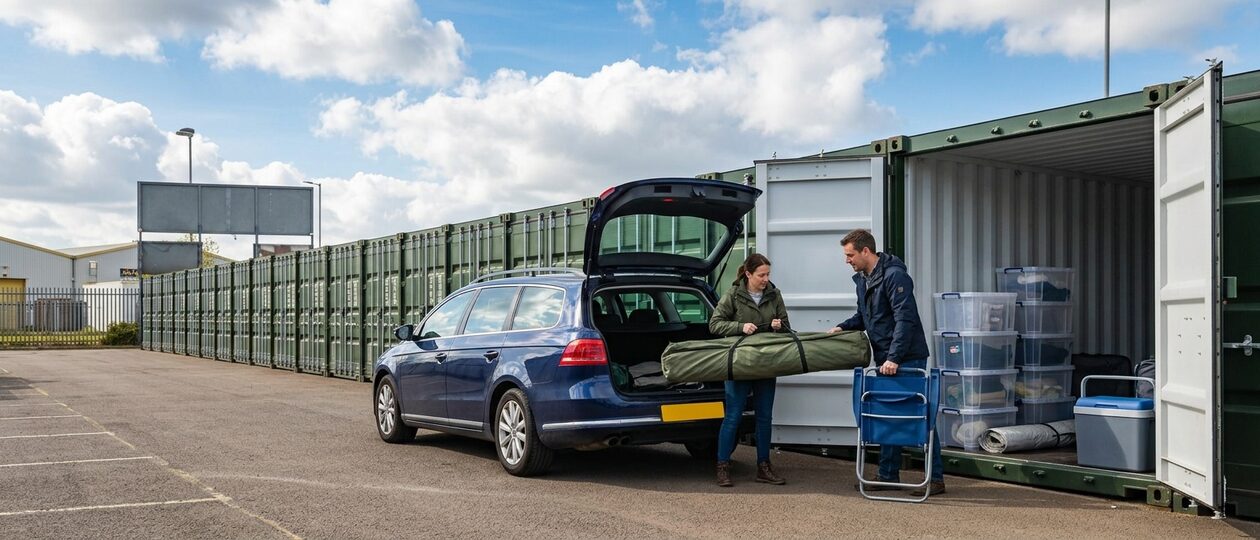
A storage unit starts to make sense when several people’s kit goes into one space and the cost is split. The 20ft container is the one size offered at all three iBOXED sites, so it’s the fairest example.
| 20ft container shared between | Each pays, per month (inc VAT) |
|---|---|
| 1 household | £118.80 |
| 2 | £59.40 |
| 4 | £29.70 |
| 6 | £19.80 |
Guide prices, checked 2 October 2026. Sizes and availability change from week to week, and not every size is offered at every site. For what's available today, with live prices, see the Redcar, Ingleby Barwick and Stockton (Preston Farm) pages.
A 20ft container is about the size of a single garage. That’s long enough for full-length hard boards and most kayaks, with room left for a freestanding rack and a clothes rail of your own for the suits. A smaller unit holds inflatables and wetsuits comfortably, but measure your longest board before you choose one. The size guide helps with that.
The same care rules apply inside a unit as at home. Everything goes in clean and bone dry, boards sit off the floor, suits hang with air around them, and a moisture trap earns its keep.
One honest point. If your kit fits under the bed, keep it under the bed. The unit is for the household or group whose kit has outgrown the house.
Where we are
Our Redcar site on Limerick Road is the closest to the beach, and there are sites at Ingleby Barwick and at Preston Farm in Stockton for anyone nearer the river. All three iBOXED sites are pinned on the map below. Access is by personal PIN at the main gate, 24 hours a day, so the first calm, sunny Saturday in spring you can collect the boards and go.