Stockton-on-Tees borough has around 1,125 wholesale and retail businesses, the largest retail base of the three Teesside boroughs and well ahead of Middlesbrough’s 875 and Redcar and Cleveland’s 690. A good share of them trade from Thornaby, between the Mandale town centre and the big sheds at Teesside Park.
Every one of those shops has the same November problem. The Christmas buy-in arrives in the first fortnight of the month, all at once, and then sells over eight weeks. The stockroom was sized for a normal week, not for a season.
Why does the Christmas buy-in break the stockroom?
Because suppliers ship the whole season in one go, and a shop only has room for what it sells this week. The gift lines, the cards, the wrap, the decorations and the January-sale stock all land within days of each other in early November, and the last of it does not go out until the sales finish in the new year.
So the overflow ends up where it always does: the back corridor, the staff loo, the garage at home, the boot of the car. Cartons get crushed, the till area shrinks and someone trips over a pallet of candles on the busiest Saturday of the year.
The fix is to stop thinking of the buy-in as one delivery and start thinking of it as three.
How many shops are we talking about?
A lot of them, and the borough’s trade is spread between a working town centre and a retail park, which is why Thornaby in particular feels the squeeze. Mandale’s independents are in older units with small back rooms. The Teesside Park traders have the opposite problem: big sales floors, expensive floor space, and a head office that wants stock on the shelf, not in a store room.
Across the UK, self-storage operators run at about three quarters full on average, and around 80% in mature stores. That is the demand line: a good part of that space is boxed stock belonging to businesses with the same seasonal shape as yours. Our post on what storage costs in the North against the UK has the regional figures if you want them.
Staging the season in three waves
Split the buy-in by the week it sells, and hold each wave off-site until that week. Only the current wave is in the shop.
| Wave | Arrives | Sells from | Where it sits until then |
|---|---|---|---|
| 1. Black Friday and early gifting | First half of November | Black Friday weekend (Friday 27 November this year) | Shop floor and stockroom |
| 2. Core Christmas lines | Early to mid November | First week of December to Christmas Eve | Off-site unit, moved across weekly |
| 3. January sales and new-year stock | Late November to mid December | Boxing Day (Saturday 26 December) onwards | Back of the unit, untouched until the week before |
Dates: calendar check, 1 November 2026. The week-by-week pattern is the same every year; only the dates shift.
The point of the table is the last column. Wave 3 is bought early because the supplier’s price is better and the delivery slot is easier, and it then spends six weeks doing nothing. That six weeks is what you are paying the stockroom for, and it is the cheapest thing to move out.
Wave 2 is the one that earns the trip. Keep a week’s selling in the shop, restock from the unit on Sunday evening or Monday morning, and the back room stays clear for the stuff that is actually moving.
How much space does a buy-in take?
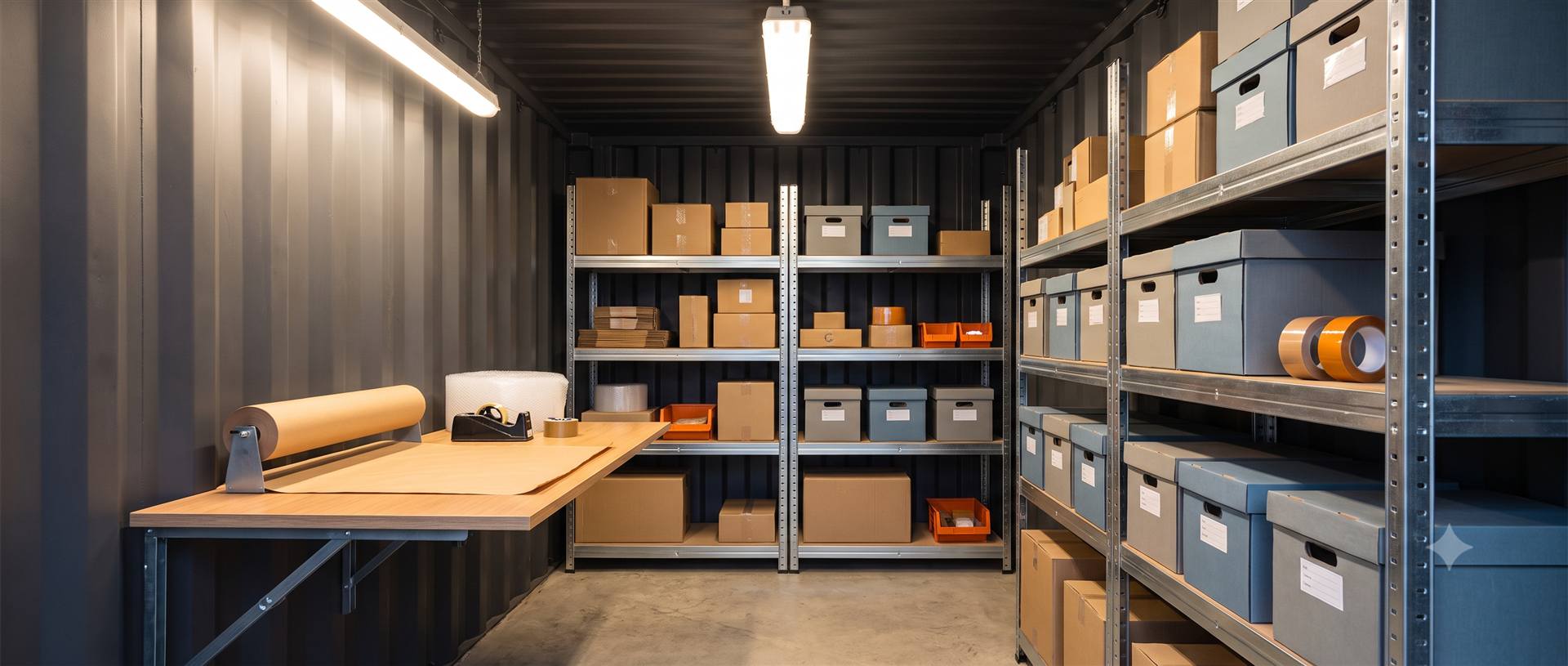
Count pallets and cartons, not guesses. The sums below use a standard UK pallet at 1.2 m by 1.0 m and a 20ft container with an internal floor of about 5.9 m by 2.35 m, which is the figure a Stockton container supplier publishes for the standard box.
- One row with a walkway: pallets with their 1.0 m side across the container, five in a row along one wall. That uses 5.0 m of the length and leaves a walkway of about 1.3 m, wide enough for a sack truck.
- Wall to wall: two rows of five, ten pallets, no walkway. Fine for wave 3 stock you will not touch until January; hopeless for anything you restock from weekly.
- Cartons: a typical 60 by 40 by 40 cm carton goes four to a layer on a UK pallet. Four layers high is 1.6 m, about shoulder height, so 16 cartons per pallet position and around 80 in the single row.
A 10ft container is half the length, so two pallet positions with a walkway, or four without. For a home-based seller with a few hundred cartons of gifts, that is usually enough. Our size guide has the rest of the range.
Keep the aisle. Every retailer who has filled a unit wall to wall has then spent an hour moving pallets to reach the one at the back.
What does short-term seasonal storage cost, and when does it beat a bigger shop?
A 20ft container is £118.80 a month including VAT, on a one-month minimum term, and that is the only size at Preston Farm. For a November-to-January season you are looking at three months and then nothing: no lease, no rates, no notice period running into the spring.
| Unit | Roughly the size of | Per month (inc. VAT) |
|---|---|---|
| 10 ft Container | Small Garage / Large Shed | £90.00 |
| 20 ft Container | Size of a Single Garage | £118.80 |
| 90 sq ft Internal (First Floor) | One Bedroom Apartment | £130.00 |
| 90 sq ft Internal | Small Garage / Large Shed | £140.00 |
| 96 sq ft Internal | Two Bedroom Flat | £150.00 |
| 108 sq ft Internal | Single Garage | £160.00 |
| 135 sq ft Internal (First Floor) | Large single garage or 7 tonne lorry; contents of a large 2-bed or small 3-bed house | £160.00 |
| 135 sq ft Internal | Large single garage or 7 tonne lorry; contents of a large 2-bed or small 3-bed house | £160.00 |
iBOXED Redcar price list, checked 2026-10-02; see current availability on the Redcar units page.
Guide prices, checked 2 October 2026. Sizes and availability change from week to week, and not every size is offered at every site. For what's available today, with live prices, see the Stockton (Preston Farm), Ingleby Barwick and Redcar pages.
The comparison that matters is with the next size up of shop premises. A bigger unit on Mandale or a larger shed at the retail park costs twelve months a year to solve an eight-week problem, and the extra rent is there in July when the back room is empty. Three months of a container is a few hundred pounds, all in, and it stops the day you no longer need it. Our trade storage post for Preston Farm works through the lease comparison for year-round stock.
At Preston Farm a three-month term also qualifies for 50% off the first month, which lines up neatly with a November start.
Running it from Thornaby
Thornaby-on-Tees is about five minutes from the nearer iBOXED site, so a Monday morning restock is a quick run rather than a planned trip. Preston Farm sits on Surtees Business Park off the A19 and A66, which is the way the delivery vans go anyway.
Access is by personal PIN at the main gate, 24 hours a day, so an early restock before the shop opens works fine. The container is secured with a high-security padlock, and you hold the key.
You can work inside the unit: pick, pack, price and label stock, split a pallet into shop-ready boxes, build the Boxing Day bundles in December. What you cannot do is treat it as a shop or an office, and if a courier or pallet firm is delivering to the unit you have to be there to let them in and sign for it. The site terms also exclude anything flammable, so petrol, gas and solvents stay out.
Ask your own insurer whether stock in storage is covered, and ask the site what cover applies.
Then, in the second week of January, the unit is empty, the last of the sale stock is on the shelf, and you hand the key back until next November. If you are near Thornaby, Stockton or Ingleby Barwick, the Preston Farm site page has the current 20ft prices, and all three iBOXED sites are pinned on the map below.