The North East gets about 60 nights of air frost a year, with winter nights averaging 0.7°C, on the Met Office’s thirty-year regional average. Add about 240 mm of rain between December and February, 18 days of snow and an average humidity of 83%, and that is what a car standing on a Teesside drive has to get through.
None of those numbers is extreme on its own. Together they describe a freeze-thaw cycle, repeated sixty times, in air that is nearly always damp. For a car that is not driven, that is the whole winter problem.
What does a Teesside winter do to a car that stands still?
It finds the water and freezes it. Rain gets into door bottoms, sills, the boot floor and the seams under the windscreen. A driven car dries out through heat and airflow. A parked one does not, so the water sits, freezes overnight, expands, and lifts paint from the inside of the panel.
Humidity does the slower damage. At 83% average, the air inside a closed car is wet enough for condensation to form on every cold surface each morning: chrome, bare metal, the inside of the glass, the brake discs. A car parked up in November with damp carpets comes out in March smelling of mould.
Then there is the salt. The A19 and A66 are gritted all winter, and a car that still does the odd commute brings that salt home to the arches. Salt and damp together are how a sound car gets a rusty underside in one season.
Should you SORN it?
If the car is coming off the road for the winter, usually yes. A SORN stops the vehicle tax and refunds the full months left, and the car then has to stay off the public road until it is taxed again.
Our motorbike winter post walks through the GOV.UK rules, the refund and the one exception for driving to an MOT. They apply to cars in exactly the same way.
The lay-up checklist: the car
In this order, because each step protects the one after it.
- Wash and dry it, including underneath. Salt and mud hold water against the metal. Hose the arches and the underside, then drive it for twenty minutes to dry the brakes and the sills before it stops for good.
- Fluids. Change the oil if it is due, because used oil is acidic. Check the coolant is at the right strength for frost; the cheap testers are fine. Top up the brake fluid.
- The fuel decision. Where the car is going decides this. At home in a garage, a full tank with a stabiliser stops condensation forming inside it. In a storage unit, the site terms rule: at iBOXED the tank is drained before the car goes in, because petrol and oil are excluded, and the engine is run until the lines are dry.
- Battery out. Disconnect it, take it home, keep it charged. A flat battery in a frost can crack.
- Tyres. Pump them up hard, ten or fifteen psi over the usual, to limit flat spots. Better still, get the car onto axle stands and take the weight off them.
- Handbrake off, wheels chocked. A handbrake left on for four months can seize the rear brakes to the drums or discs.
- Breathable cover. Never a tarpaulin or anything plastic. A breathable cover lets the damp out; a plastic one traps it against the paint. A rag in the tail pipe, and a note on the dash to say so.
The lay-up checklist: the project
This is the half most guides skip, and it is where the real money sits. A dismantled car is a thousand parts that each need to come out of winter the way they went in.
- Box the engine properly. On a stand or a pallet, bores oiled, every opening taped or bunged, the whole thing under a breathable sheet. Not on the floor.
- Panels on edge, not flat. Wings and doors stacked flat warp and scratch. Stand them on their edge on carpet offcuts, bare metal wiped with oil or a wax coating, nothing touching anything else.
- Interior and chrome. Seats and trim in breathable bags with a moisture trap, never polythene. Chrome wiped, then wrapped in soft cloth. Leather fed before it goes away.
- Small parts in labelled boxes. Clear lidded boxes, one assembly per box, the fixings in a bag inside it. “Front suspension, nearside” on two sides of the box.
- Tools. Wiped, oiled, in a dry toolbox with a sachet of silica gel. Our tool storage post covers keeping a trade’s worth of tools dry and safe.
- The inventory sheet. One page, taped inside the lid of the first box: what is in every box, what has been sent away for machining, what still needs buying. In March, this sheet is the project.
Where does it all live?
Wherever is dry, frost-free and lockable, which on Teesside’s newer estates rules out most of the options. A single garage fills with the project long before the car gets in, the drive is where the frost and salt are, and a borrowed barn is dry until the week it is not.
| What | At home | In a storage unit |
|---|---|---|
| The car itself | Garage or drive under a breathable cover, battery out | 20ft container, by arrangement, tank drained |
| Engine and gearbox | Garage floor on a pallet, oiled and sheeted | Pallet or stand, drip tray underneath, no cans of oil or fuel |
| Panels and doors | Against the garage wall on edge | Along one wall of the unit on edge, carpet underneath |
| Interior, chrome, trim | Spare room or loft in breathable bags | Boxed, off the floor, moisture trap in the unit |
| Wheels and tyres | Stacked on their side in the garage | Stacked, bagged, pressures dropped a little |
| Tools and small parts | The garage, if there is still room | Labelled lidded boxes on shelving, inventory on the lid |
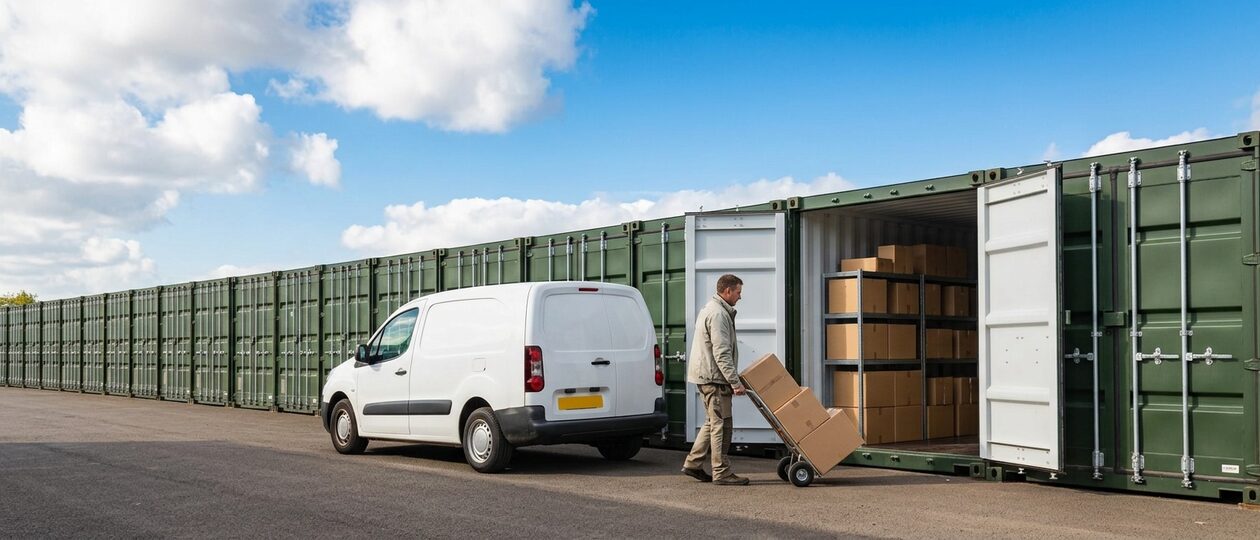
A 20ft container has an internal floor of about 5.9 m by 2.35 m. A car under about 4.5 m long and 1.7 m wide goes in with a walkway at one end and a few inches each side, so expect to climb out at the back. A 10ft container, at half the length, is the parts-and-kit option: the engine, panels, boxes and shelving, while the car stays under its cover at home.
| Unit | Roughly the size of | Per month (inc. VAT) |
|---|---|---|
| 10 ft Container | Small Garage / Large Shed | £90.00 |
| 20 ft Container | Size of a Single Garage | £118.80 |
| 90 sq ft Internal (First Floor) | One Bedroom Apartment | £130.00 |
| 90 sq ft Internal | Small Garage / Large Shed | £140.00 |
| 96 sq ft Internal | Two Bedroom Flat | £150.00 |
| 108 sq ft Internal | Single Garage | £160.00 |
| 135 sq ft Internal (First Floor) | Large single garage or 7 tonne lorry; contents of a large 2-bed or small 3-bed house | £160.00 |
| 135 sq ft Internal | Large single garage or 7 tonne lorry; contents of a large 2-bed or small 3-bed house | £160.00 |
iBOXED Redcar price list, checked 2026-10-02; see current availability on the Redcar units page.
Guide prices, checked 2 October 2026. Sizes and availability change from week to week, and not every size is offered at every site. For what's available today, with live prices, see the Stockton (Preston Farm), Ingleby Barwick and Redcar pages.
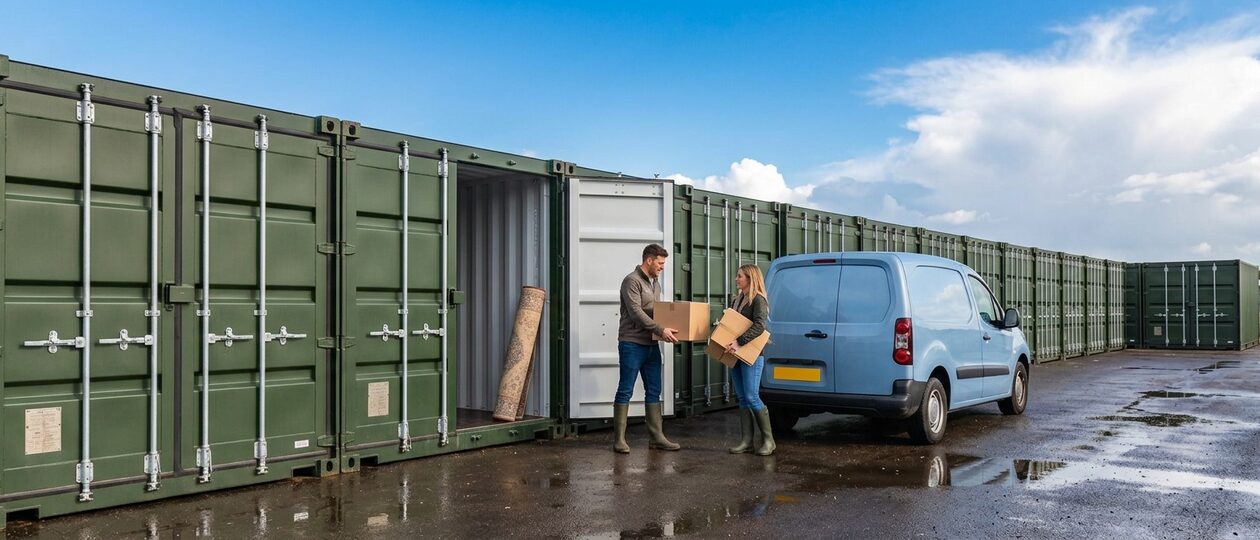
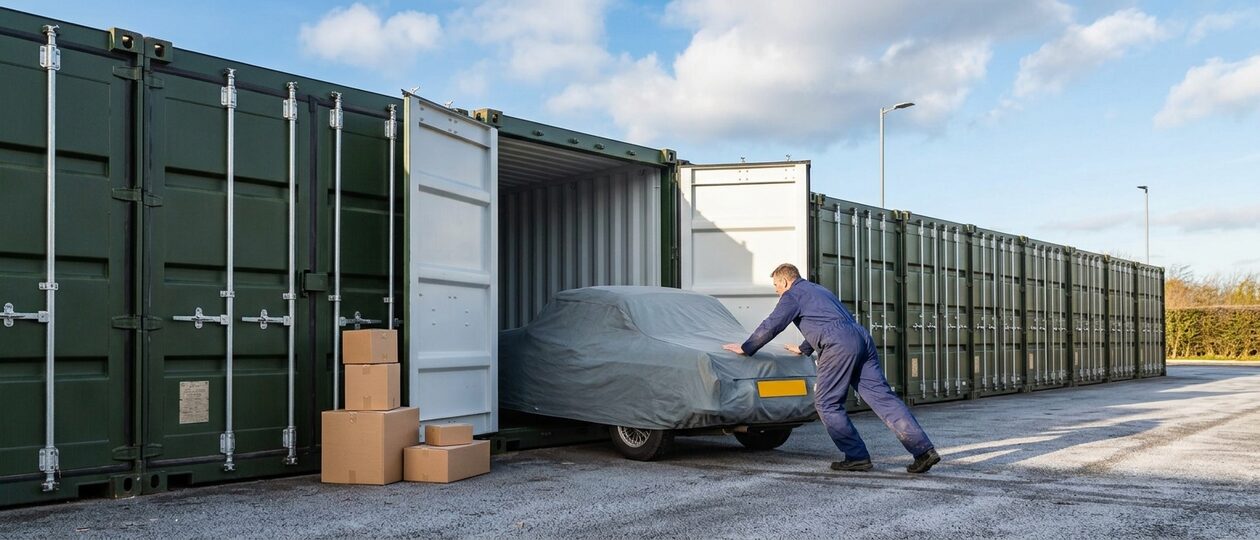
At iBOXED a car or project car goes into a 20ft container by arrangement, agreed with the site case by case in the same way as a motorbike, with the tank drained before it arrives. Nothing about power or trickle charging inside a unit is confirmed, so the battery comes home with you. Access is by personal PIN at the main gate, 24 hours a day, under 24-hour CCTV, and the container is secured with a high-security padlock, and you hold the key. The minimum term is one month, so a November-to-March lay-up is a five-month arrangement and then it ends.
Check with your insurer about a laid-up car. A SORN removes the legal need for cover, but fire and theft do not care about tax status, and whether to keep cover is a conversation for them. Ask your own insurer whether a car or parts in storage are covered, and ask the site what cover applies.
Getting it moving again in spring
Reverse the list. Battery in and charged, tyres down to the right pressure, a look underneath for drips and nests, fluids checked, fuel back in if it was drained, then the brakes pumped a few times and a gentle first run rather than a motorway blast.
The project half comes out in the order on the inventory sheet. If the car needs a home for the winter, our Preston Farm site on Surtees Business Park, off the A19 and A66, is 20ft containers only and the natural one to ask. All three iBOXED sites are pinned on the map below.